
In the industrial manufacturing world, selecting grinding tools that marry exceptional durability with reliable safety is paramount. Brazed diamond grinding tools, renowned for their robust structure and superior abrasive performance, have become the gold standard for precision machining across diverse industries. This article delves into their core technology, application scope, and practical benefits, illustrating why these tools set benchmarks for optimal production efficiency and workplace safety.
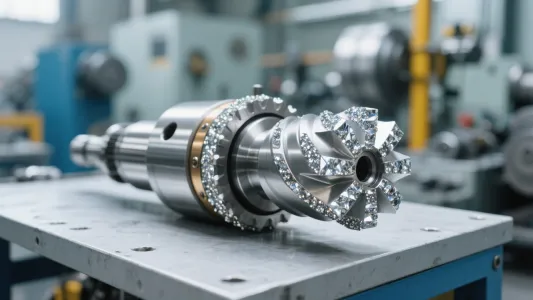
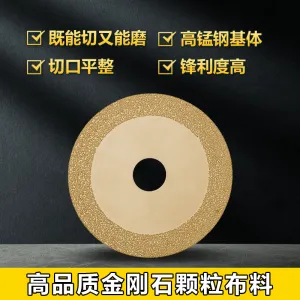
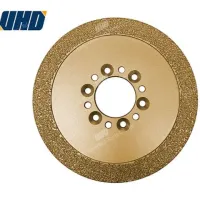
Brazed diamond grinding tools are engineered by securely bonding synthetic or natural diamond grains onto a metal substrate through a high-temperature brazing process. This method enables a dense and uniform diamond coating that dramatically enhances the tools’ abrasive capability and longevity. Compared to conventional electroplated or resin-bonded abrasives, the brazing process yields a 25%-40% increase in tool life under typical industrial wear tests.
The rigorous brazing ensures superior structural integrity, minimizing diamond grain detachment or coating delamination during heavy-duty grinding. Consequently, these tools exhibit outstanding resistance to mechanical shocks, heat buildup, and chemical corrosion, making them ideal for sustained high-speed operations.
The diamond’s intrinsic hardness combined with the robust brazed bonding translates into exceptional wear resistance —tool wear rates are typically 30%-50% lower than that of resin-bonded equivalents. This durability results in longer operational cycles, reducing tool change downtime and overall machining costs.
Moreover, the metal bond matrix protects the diamond abrasives from fracturing under excessive grinding forces, maintaining a consistent cutting profile that guarantees precision finishes and dimensional accuracy.
Brazed diamond grinding tools offer remarkable versatility. They efficiently process a broad array of hard and brittle materials, including:
Industry sectors such as automotive, aerospace, construction, and tooling heavily rely on these tools for high-precision grinding, shaping, and finishing tasks. For instance, in automotive gear manufacturing, brazed diamond wheels deliver surface roughness improvements by up to 20% compared to traditional abrasives.
Consider the experience of a leading stone fabrication plant that replaced conventional bonded wheels with brazed diamond grinding tools. Within six months, they observed:
| Performance Metric | Before Brazed Tools | After Brazed Tools |
|---|---|---|
| Tool Life (hours) | 120 | 180 (+50%) |
| Production Throughput (units/day) | 450 | 540 (+20%) |
| Safety Incidents Related to Tool Failure | 3 per quarter | 0 (Improved) |
Such improvements underscore the crucial role brazed diamond tools play in not only enhancing machining efficiency but also significantly elevating operator safety by reducing breakage and hazardous debris.
Manufacturers like Henan Yode Superhard Tools Co., Ltd. prioritize stringent quality control and continuous innovation to meet evolving market demands. Their brazed diamond grinding tools undergo comprehensive testing, including hardness verification, bonding strength analysis, and real-world performance trials. Customers benefit from professional technical support and after-sales services designed to optimize tool selection and lifecycle management.
Yode’s commitment aligns with industry standards such as ISO 9001 and offers customization tailored to specific application requirements, enabling enterprises to maximize return on investment and production consistency.
The demand for tools that minimize downtime and produce superior surface finishes is ever-increasing. Brazed diamond grinding tools deliver measurable productivity gains by:
These factors contribute directly to improving a company's competitive edge in demanding global markets.

 150
|
150
|
 brazed diamond grinding tools
high-wear grinding solutions
diamond tool selection guide
industrial grinding tool optimization
efficient diamond abrasives
249
|
Brazed diamond grinding discs
High - efficiency grinding
Wear resistance
Hard alloy processing
Grinding tools
brazed diamond grinding tools
high-wear grinding solutions
diamond tool selection guide
industrial grinding tool optimization
efficient diamond abrasives
249
|
Brazed diamond grinding discs
High - efficiency grinding
Wear resistance
Hard alloy processing
Grinding tools
 443
|
brazed diamond grinding wheels
precision stone cutting tools
wear-resistant grinding discs
brazing technology innovations
high-performance industrial abrasives
377
|
Brazed diamond grinding tools
Precision ceramic grinding
Diamond grinding disc selection
Industrial grinding solutions
Super - hard material processing
443
|
brazed diamond grinding wheels
precision stone cutting tools
wear-resistant grinding discs
brazing technology innovations
high-performance industrial abrasives
377
|
Brazed diamond grinding tools
Precision ceramic grinding
Diamond grinding disc selection
Industrial grinding solutions
Super - hard material processing
 103
|
brazed diamond grinding wheels
precision machining applications
wear-resistant diamond tools
industrial grinding solutions
high-end manufacturing case study
103
|
brazed diamond grinding wheels
precision machining applications
wear-resistant diamond tools
industrial grinding solutions
high-end manufacturing case study






.png?x-oss-process=image/resize,m_fill,h_300,w_300/format,webp)


.png?x-oss-process=image/resize,m_fill,h_200,w_200/format,webp)

