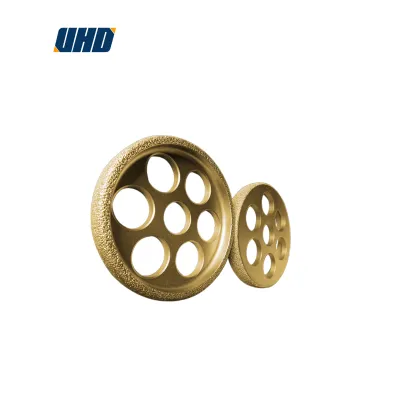
Selecting the right diamond grinding disc is critical for industrial processing operations to balance processing precision, working efficiency, tool service life and overall cost performance. For procurement managers, production supervisors and technical personnel in metalworking, stone processing, glass and ceramic manufacturing, understanding the core factors that define grinding disc performance helps avoid frequent tool wear, unstable processing results and unnecessary operation losses. As a specialized ultrahard material tool manufacturer with years of R&D and production experience, UHD Ultrahard Tools provides a systematic reference framework for diamond grinding disc selection for different industrial application scenarios.
The actual working performance of a diamond grinding disc is not determined by a single indicator, but by the coordinated performance of three core design dimensions: particle size selection, binder material and structural design. Adjusting any of these dimensions will directly affect the final processing result and application suitability:
Coarse diamond particles are suitable for heavy stock removal and high-efficiency rough grinding, while fine particles are more ideal for finish grinding and achieving high surface finish requirements. Improper particle size matching may lead to slow grinding speed, easy clogging of the grinding surface or insufficient processing precision.
Common binders include resin, metal and brazed bonding systems. Among them, the brazed bonding process forms a firm metallurgical combination between diamond grains and the substrate, which can provide higher holding force, help the diamond grains to be fully exposed during the grinding process, and avoid premature shedding of abrasive grains under high-load working conditions.
A reasonable substrate design, abrasive grain distribution and overall structural strength directly affect the stability, heat dissipation performance and service life of the grinding disc during high-speed operation. A grinding disc with insufficient structural strength is prone to deformation and excessive vibration during use, which further reduces processing accuracy and operation safety.
Compared with traditional electroplated or resin-bonded diamond grinding discs, the brazed diamond grinding series represented by UHD 100mm brazed diamond grinding 100 has obvious performance improvements in structural strength, grinding efficiency and service life, and is very suitable for industrial scenarios that require continuous high-intensity operation.
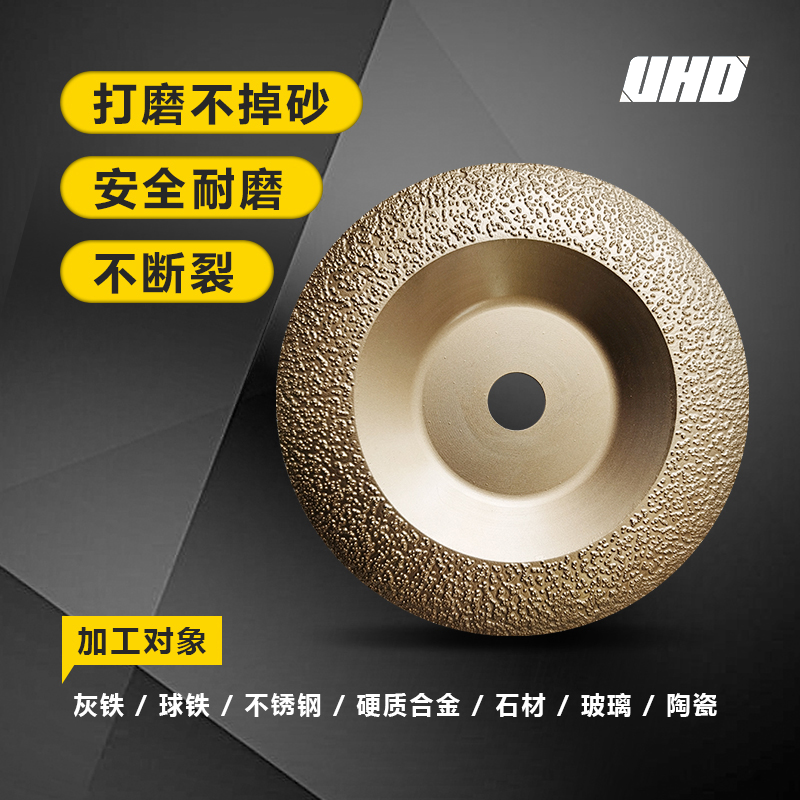
Different industrial processing scenarios put forward different requirements for grinding discs, and selecting products according to actual material characteristics and process standards can maximize the comprehensive value of the tools:
| Typical Processing Scenarios | Core Processing Needs | Adaptation Suggestion |
|---|---|---|
| Metal Processing (Cast Iron, Stainless Steel) | Heavy stock removal, wear resistance, low replacement frequency | Brazed diamond grinding discs with high bond strength are recommended |
| Stone Processing | Efficient grinding, stable surface finish, long continuous working life | 100mm brazed diamond grinding disc with uniform abrasive grain distribution is suitable |
| Glass & Ceramic Precision Machining | High precision, low chipping, good surface quality | Select brazed grinding products with matched particle size according to finish requirements |
| Cemented Carbide Machining | High hardness, difficult to process, requiring sharp and durable abrasives | High-strength brazed diamond grinding tools can achieve better processing results |
As a high-tech enterprise focusing on the R&D, production and sales of superhard material tools, UHD Ultrahard Tools cooperates closely with well-known universities to continuously optimize product performance, and provides reliable superhard material tool solutions for global industrial customers through a complete B2B service system. When selecting diamond grinding discs, reasonably matching the three core dimensions of particle size, binder and structural design according to the actual processing materials, equipment conditions and process requirements is the key to obtaining stable and efficient grinding performance.

 62
|
62
|
 UHD Ultrahard Tools superhard material tools diamond tools brazed diamond abrasives metal and stone processing
 392
|
UHD Ultrahard Tools vacuum brazed diamond abrasives diamond cutting tools superhard material tools industrial processing
392
|
UHD Ultrahard Tools vacuum brazed diamond abrasives diamond cutting tools superhard material tools industrial processing
 318
|
UHD Ultrahard Tools vacuum brazed diamond tools superhard material tools diamond cutting abrasives metal processing
49
|
UHD Ultrahard Tools 100mm brazed diamond grinding disc grinding disc assembly and inspection grinding speed and angle adjustment grinding disc safety maintenance
69
|
UHD Ultrahard Tools vacuum brazed diamond tools diamond cutting abrasives industrial processing tools ultrahard materials tools
318
|
UHD Ultrahard Tools vacuum brazed diamond tools superhard material tools diamond cutting abrasives metal processing
49
|
UHD Ultrahard Tools 100mm brazed diamond grinding disc grinding disc assembly and inspection grinding speed and angle adjustment grinding disc safety maintenance
69
|
UHD Ultrahard Tools vacuum brazed diamond tools diamond cutting abrasives industrial processing tools ultrahard materials tools





.png?x-oss-process=image/resize,m_fill,h_300,w_300/format,webp)
.png?x-oss-process=image/resize,m_fill,h_400,w_400/format,webp)