
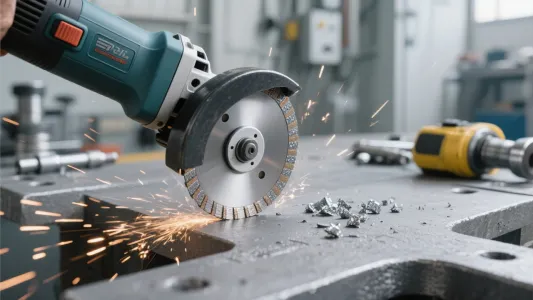
In the realm of high - end machining, traditional abrasives often fall short. They lack the necessary hardness and precision to handle difficult - to - machine materials such as gray iron, stainless steel, and ceramics. For instance, when grinding gray iron, traditional grinding wheels may experience rapid wear and tear, leading to inconsistent surface finishes and frequent wheel replacements. This not only increases the cost but also reduces the overall machining efficiency. In contrast, the advanced technology of brazed diamond grinding discs offers a more reliable solution.
The brazing process used in manufacturing brazed diamond grinding discs is a game - changer compared to the traditional binder process. In the binder process, diamonds are held in place by a bonding agent. However, this method has limitations in terms of the strength of the bond, which can cause diamonds to fall off prematurely during grinding. On the other hand, the brazing process forms a strong chemical bond between the diamond particles and the base material. This allows the grinding discs to withstand higher pressures and temperatures, offering a longer service life. Studies have shown that brazed diamond grinding discs can last up to 3 times longer than those made with the binder process.
Selecting the right diamond particle size and concentration is crucial for different workpiece materials. For gray iron, a medium - sized diamond particle with a relatively high concentration is recommended. This combination can effectively remove material while maintaining a good surface finish. When it comes to stainless steel, a finer diamond particle size with a moderate concentration is more suitable to prevent overheating and ensure precision grinding. For ceramics, a coarser diamond particle can be used to break through the hard surface. A selection table can be provided to illustrate the best combination for various materials (see below).
| Workpiece Material | Diamond Particle Size | Diamond Concentration |
|---|---|---|
| Gray Iron | Medium | High |
| Stainless Steel | Fine | Moderate |
| Ceramics | Coarse | Moderate |
The shape and size of the grinding disc also play a vital role in the machining process. Planar grinding discs are ideal for flat surface grinding, such as in the production of metal sheets. They provide a uniform grinding effect and are suitable for large - area processing. Curved grinding discs, however, are more suitable for grinding complex shapes, such as the contours of mechanical parts. The diameter of the grinding disc typically ranges from 100mm to 180mm. A smaller diameter disc (around 100mm) is more suitable for precision grinding in tight spaces, while a larger diameter disc (150 - 180mm) can cover a wider area and increase the grinding efficiency.
One of the significant selling points of Youde's brazed diamond grinding discs is their focus on safety and longevity. The anti - impact design and precise control of fracture risks ensure that the grinding discs do not break during operation, which is crucial for the safety of operators. Moreover, the company offers a quality commitment through manual measurement, ensuring that each grinding disc meets high - quality standards. This results in a longer service life and fewer interruptions during the machining process.
A mechanical processing factory reported significant efficiency improvements and reduced losses after switching to Youde's brazed diamond grinding discs. The factory's production efficiency increased by 30% due to the longer service life of the grinding discs, which reduced the frequency of disc replacements. Meanwhile, the product loss rate decreased by 20% because of the more consistent surface finish provided by the high - quality grinding discs.

 437
|
437
|
 brazed diamond grinding tools
aerospace material processing
diamond grinding wheel durability
high-efficiency grinding solutions
titanium alloy machining
408
|
Brazed diamond grinding discs
Bowl - shaped diamond grinding tools
Brazed grinding disc selection
Diamond grinding disc performance
Hard alloy grinding tools
185
|
brazed diamond grinding wheel
machining efficiency improvement
diamond abrasive tools
high hardness grinding
grinding safety technology
377
|
Brazed diamond grinding tools
Precision ceramic grinding
Diamond grinding disc selection
Industrial grinding solutions
Super - hard material processing
brazed diamond grinding tools
aerospace material processing
diamond grinding wheel durability
high-efficiency grinding solutions
titanium alloy machining
408
|
Brazed diamond grinding discs
Bowl - shaped diamond grinding tools
Brazed grinding disc selection
Diamond grinding disc performance
Hard alloy grinding tools
185
|
brazed diamond grinding wheel
machining efficiency improvement
diamond abrasive tools
high hardness grinding
grinding safety technology
377
|
Brazed diamond grinding tools
Precision ceramic grinding
Diamond grinding disc selection
Industrial grinding solutions
Super - hard material processing
 201
|
Brazed diamond grinding discs
Superhard grinding tools
Diamond grinding wheels
Cast iron processing tools
Precision grinding solutions
201
|
Brazed diamond grinding discs
Superhard grinding tools
Diamond grinding wheels
Cast iron processing tools
Precision grinding solutions






.png?x-oss-process=image/resize,m_fill,h_300,w_300/format,webp)


